
The price does not come from the list
Often it comes from the last price that customer paid. Neither average price nor cost: the history and what was agreed.
Module 03 · Integrafy Platform · The decision operating system
KnowOSThe knowledge that decides a sale and does not fit in an ERP field: PDF price lists, price history, agreed terms and internal procedures. Queryable in natural language, with the source cited.
The challenge
In most industrial and distribution companies, the commercial decision depends on information that lives in no system: it is in PDFs, in emails and in the experience of whoever has been there for years.
Often it comes from the last price that customer paid. Neither average price nor cost: the history and what was agreed.
Readable by a person, not by a system. And they are the real source of much of the commercial terms.
“I need all these contacts from the last five years” ends up as a SQL query, a ticket to IT and a queue.
When someone key retires or leaves, their judgement disappears and there is no record of how decisions were made.
Negotiating off-list is an advantage as long as the reasoning is available when needed. It stops being one when it depends on a specific person picking up the phone.
Integrafy KnowOS
It connects the company systems (ERP, PIM, files, documentation) and turns them into a living model of the business. It lets you understand what is happening, why, and what to do about it.
It does not replace the ERP or the PIM: it makes them queryable. And it does not replace the people who know: it multiplies their reach, so they stop repeating the same thing every day.
Where KnowOS sits in Integrafy Platform
KnowOS works on the knowledge base: the operational data synced from the ERP and the PIM, plus the company documentation. Natural-language conversation and agents sit on top.
How it works
Every source enters through the same door, is normalised and indexed. The query decides which retrieval mechanism to use.
The rule that governs everything
It never improvises. And a twelve-minute call is not knowledge: what matters is the criterion that appears inside it for twenty seconds. The system looks for that and discards the rest.
Every answer cites its source and the date it was said. Without enough backing, the system says so.
If someone cannot see the margin in the ERP, they cannot see it by asking either. Permissions are inherited from the source system.
Every criterion can be adjusted, withdrawn or replaced. When two sources contradict each other, the system does not choose: it flags it.
What really matters
Models change every few months. The map of your business (what exists, how it relates, who can see what and what can be done) is what turns any model into someone who knows your company.
What an ontology is · explained without jargon
| CLI_ID | NOM_ABR | ORG_V | COND_P | GRP |
|---|---|---|---|---|
| 0000100234 | SUMIN.NORTE SL | 1000 | Z030 | 02 |
| 0000100871 | FERRET.CAMPS | 1000 | Z060 | 05 |
| 0000101102 | INST.LEVANTE | 2000 | Z030 | 02 |
| 0000101377 | ELECTR.RIBA | 1000 | Z090 | 07 |
| DOC_V | POS | MAT_ID | CANT | PR_NET |
|---|---|---|---|---|
| 4500012 | 010 | A-4471-B | 24 | 38.15 |
| 4500012 | 020 | A-0930-X | 6 | 112.40 |
| 4500019 | 010 | A-4471-B | 40 | 36.90 |
Codes and columns only their designer understands. An AI model reading this guesses.
Objects with business names, connected to each other. The same data, now with meaning: an AI model reading this reasons.
The grammar of your company
Data, logic, action and security in the same place. That is why the AI does not just find the data: it understands what it means and what can be done with it.
Customer, order, product, price list, document, criterion.
What describes each object: market, payment terms, risk.
An order is placed by a customer and contains products.
Create quote, approve discount, replenish stock. With rules and validations.
They travel with every object, every property and every action.
e.g. Suministros Norte, S.L.
source: ERP + CRM + email
Illustrative example · a “Customer” object with everything the AI needs to know about it
Relational + vector
The ERP knows how much a customer bought. Email knows what they were promised. Until now they were two worlds. The ontology anchors them to the same object.
Every row and every document fragment is anchored to a business object. That is why one question can cross what happened with what was agreed.
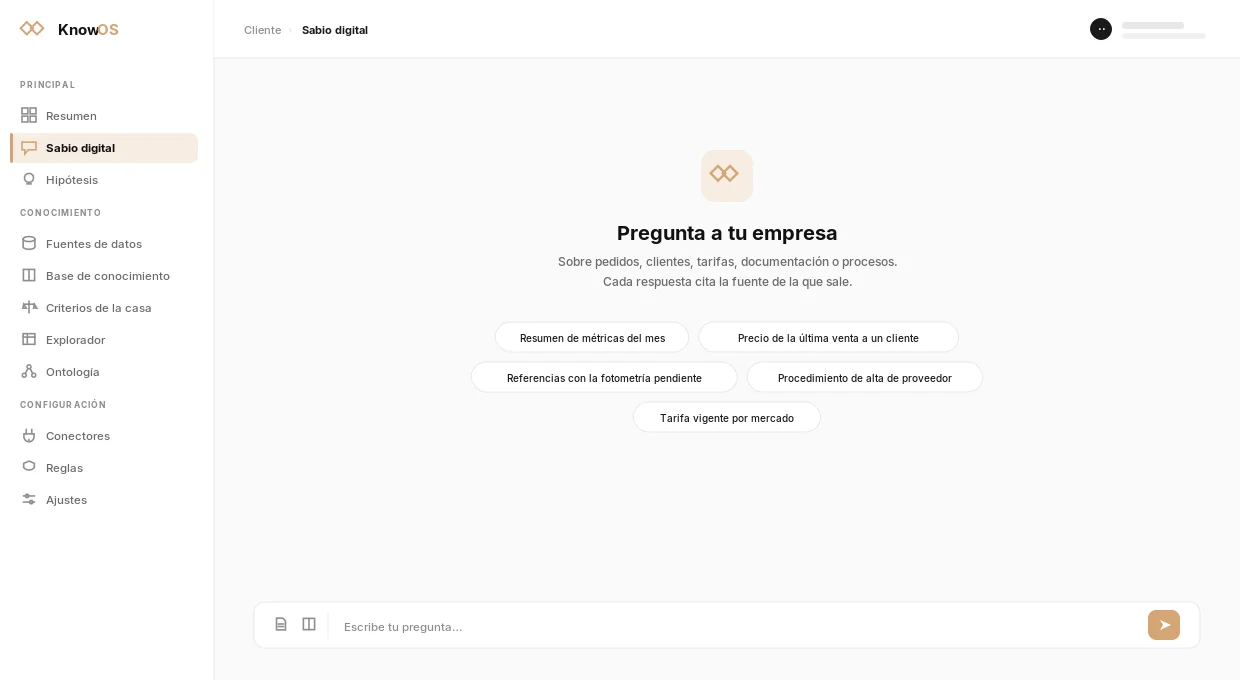
“What terms have we agreed with Suministros Norte and how much have they bought in the last 12 months?”
Customer invoices in the ERP
€184,600 · +12% year on yearsource: ERP · salesAccount email and contract
8% discount on family Asource: account manager emailBoth figures together, with both sources cited.
Endpoint · MCP · per-token permissions
The model never sees the database. It sees tools with business names, and only the ones its token allows it to use.
find_customer()orders_of(customer)current_price(product, customer)search_documents(text)propose_discount() · actionAudit · who asked, with which token, which tool they used and which data they received
Segmentation by token · illustrative example
Each person talks to the part of the company that belongs to them. You do not build one assistant per department: there is one, and the token decides what each person sees.
Revenue of €184,600 and an 18.4% margin. Down two points due to off-list discounts on family A.
Revenue of €184,600, 12% more than last year. Margin is not available for your profile.
This customer is not in your portfolio. I cannot give you their data.
Step by step
Audit · records every step · the model never touches the database: it only sees what the token lets it see
Agents under the same rules
The ontology does not distinguish between a person and an agent: both ask permission to read and to act. That is why agents can be connected without opening the database.
Comparison
ChatGPT, Claude or Gemini can be used alone or connected to KnowOS through MCP. The difference is where the rules live.
Company context
With direct AI, each person supplies the context in each conversation. With KnowOS, the company context is already loaded, the same for everyone, and respects what each person may see.
Each person uploads their own version of the files. Every conversation starts from scratch.
What does not fit in the context window gets summarised or left out.
Whichever model each one prefers · GPT · Claude · Gemini
One context for the whole company. The model only pulls what it needs.
KnowOS architecture
Ingestion, Data Lake, models, ontology and AI that discovers patterns and generates validated hypotheses. No code and no technical data team.
ERP, eCommerce, CRM, CSV or APIs, no manual pipelines
Versioning and lineage built in, partitioned by customer and by time
Business objects that generate REST and GraphQL APIs
Objects, relationships and actions, readable by AI via MCP
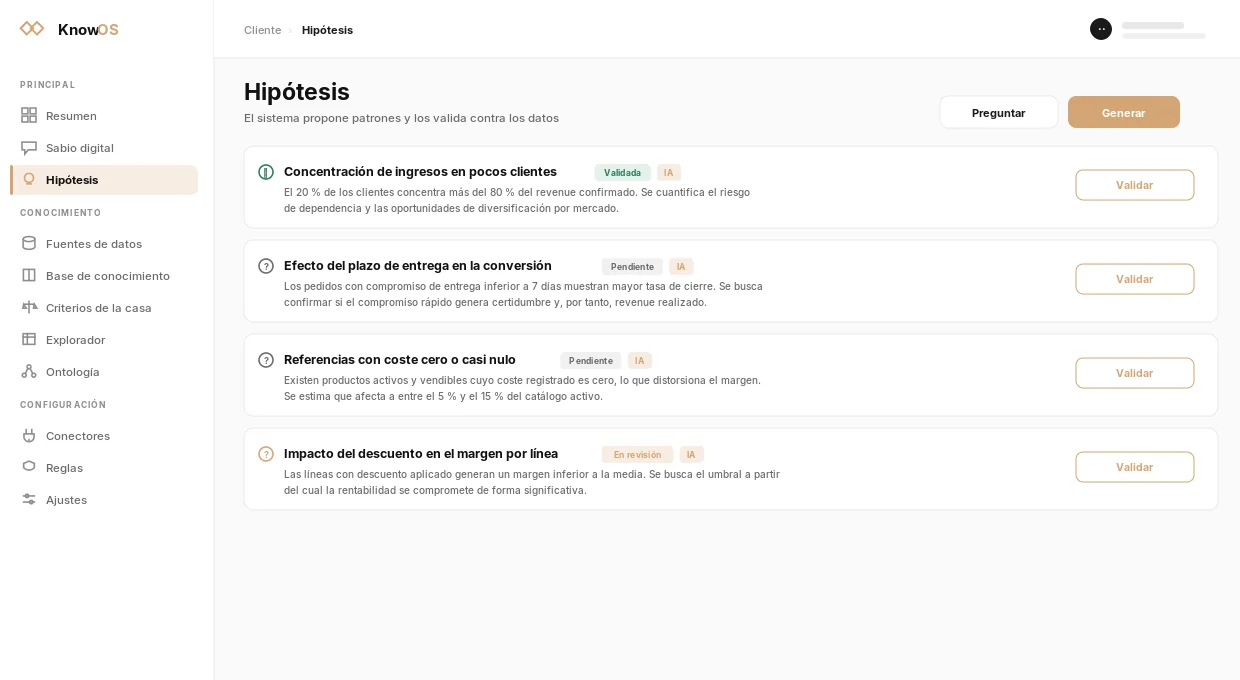
Correlations detected and validated against real data
When a pattern is confirmed, it becomes an alert or a rule. And the cycle starts again.
Summary
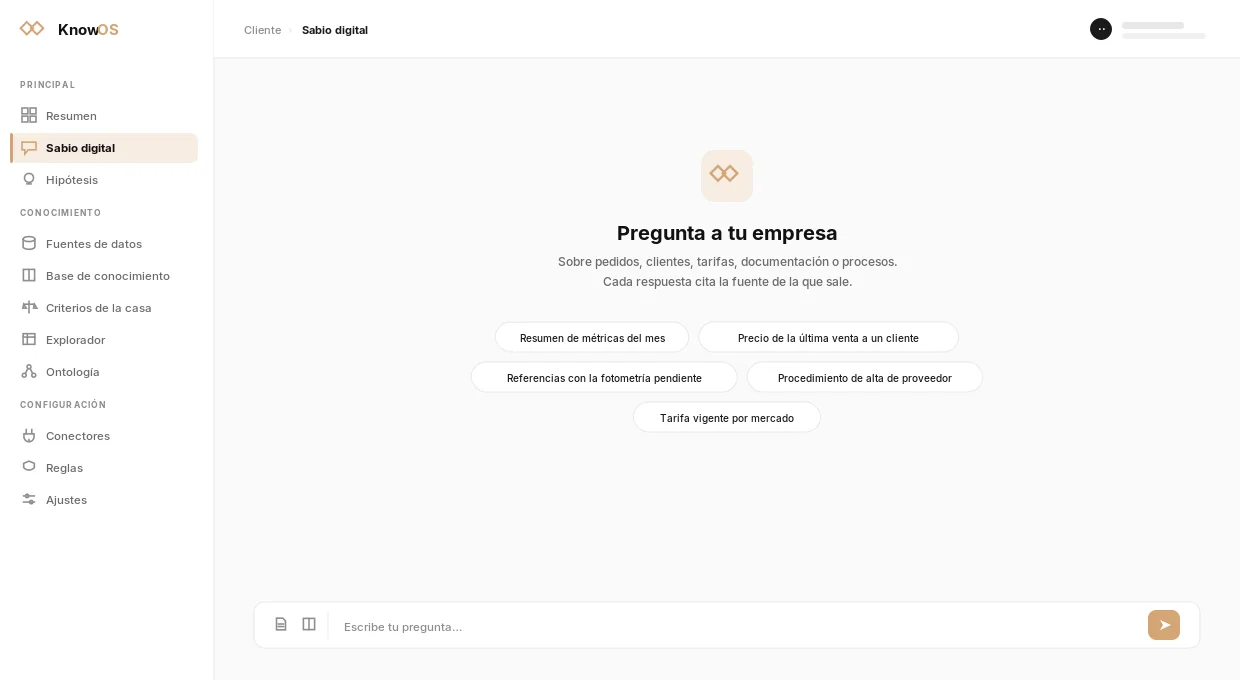
Digital sage
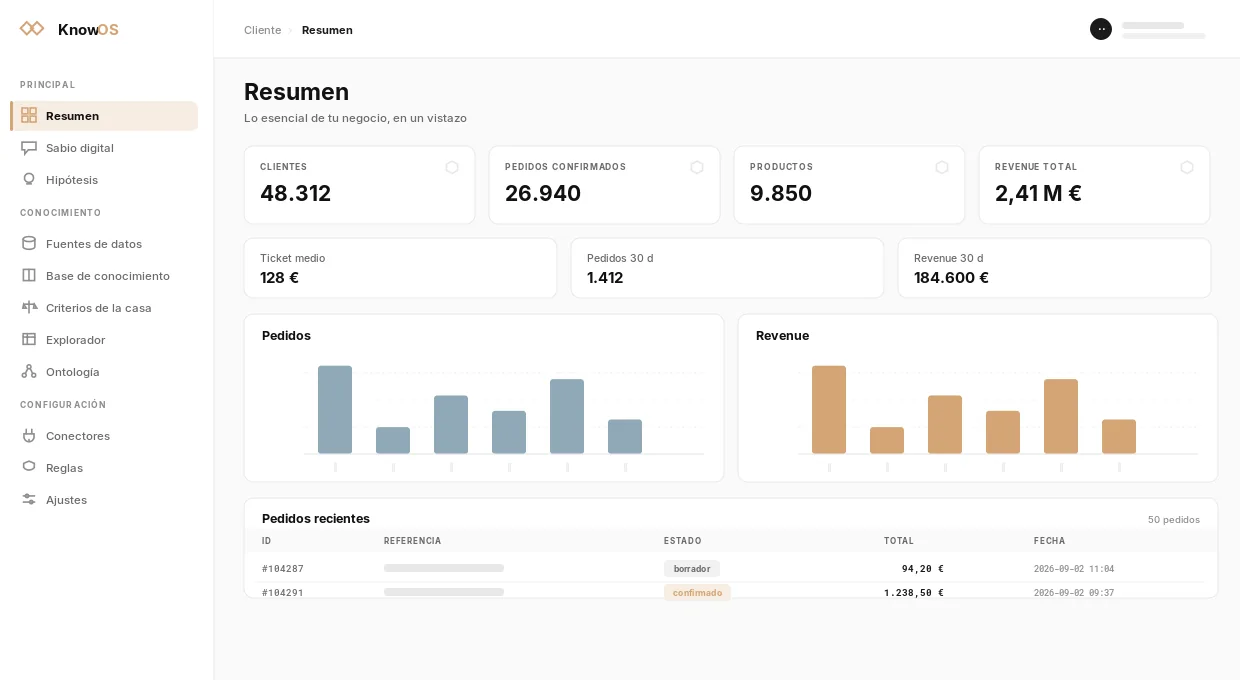
Hypotheses
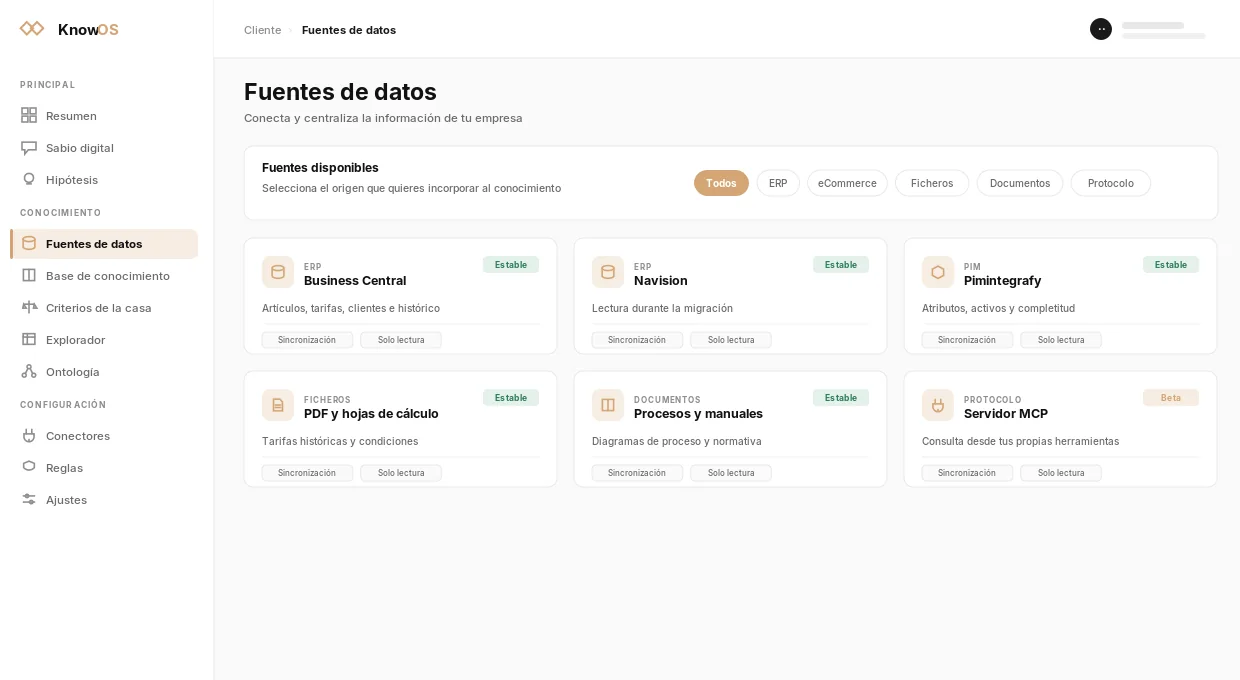
Data sources
Use cases
The same questions that today circulate by email, by phone or as a ticket to IT.
| Area | Typical question | Where the answer comes from |
|---|---|---|
| Management | “How has the average price of this family evolved over the last three years by market?” | ERP history crossed with archived price lists. |
| Sales | “What price and terms did we give this customer for this reference last time?” | Customer, product and price ontology, plus the email and price lists for that account. |
| Technical office | “Which references in this family still have the datasheet pending?” | Integrafy Data, with the completeness traffic light. |
| Marketing | “Which products are complete in German and ready to publish in the catalogue?” | Per-language and per-channel states in the PIM. |
| Operations | “What is the procedure to onboard a new supplier?” | Process diagrams and internal documentation. |
| New joiners | “I just joined. How do I process a sample for a new customer?” | Criteria base, without taking up a colleague’s time. |
Deliverables
Organised by area, with an owner and a review date. Exportable to PDF or to your intranet.
Generated from the recorded criteria and ordered by real query frequency, not by creation order.
In the browser and, if you prefer, in Teams or Slack. Every answer cites the source criterion and its date.
The knowledge stays queryable from your own tools, including Integrafy Data.
Findings become actions on the connected systems: alerts, tasks and notices. Always as a draft for review.
The criteria and the knowledge base are yours and exportable in an open format. No vendor lock-in.
Security and data
Signed before touching a single file. It sets purpose, scope, retention period and the list of sub-processors with their location.
Models work in zero-retention mode: the provider does not keep the submitted content or use it for training.
Contracted in the customer’s name, with no intermediation or surcharge. The information stays within your perimeter.
Pseudonymised before indexing, with the mapping table encrypted and stored separately.
By role and by source. What cannot be seen in the source system cannot be seen by asking either.
Who asked what, what was answered and with which source. Every criterion with its origin and its last review date.
Rollout
Roadmap
The architecture is designed to evolve towards agents that operate proactively on the business. It is not what you contract at the start: it is what this phase makes possible.
Real-time control, cash alerts and profitability projections by family and market.
Advanced sales analysis, cross-selling opportunity detection and predictive pipeline management.
Process optimisation, intelligent stock management and logistics efficiency.
None of this can be built on scattered data. The ontology and the criteria corpus are the prerequisite, and they are exactly what KnowOS delivers.
Plans
Monthly fee with no lock-in plus a one-off setup that includes ontology modelling and criteria capture. Prices exclude VAT.
To start asking the ERP and the company documents.
Onboarding · €2,490 · ERP and Drive or OneDrive
For teams that query the ERP, the store and documentation daily.
Onboarding · €3,900 · includes 20 h of customization
For companies that cross ERP, CRM, store, documents and calls.
Onboarding · from €5,950 · with CRM, eCommerce and speech to text
Agents that read, detect and propose with their own token.
By scope, after the diagnosis
Setup is quoted by number of sources and pilot domain. Language-model consumption is at cost or with a monthly allowance. On-premise option on request.
See the full price list, packs and add-ons →It is module 03 of Integrafy Platform, the knowledge layer. It works on the operational data synced by Connect, Data and Flow, but it can be contracted independently: read access to the ERP and to the company documentation is enough.
In where the rules live. With direct AI, each person uploads their files and the context is lost when the chat closes. KnowOS keeps the ontology, current criteria and permissions always loaded, the same for the whole company, and every answer cites its source and date. The model can be swapped without touching the integration.
The system answers that it is not on record. It never completes an answer with what seems reasonable. And when two sources contradict each other, it does not choose: it flags it so a person can resolve it.
Only if they can see it in the source system. Permissions are inherited from the source and applied per token: role, rows, columns and actions. The same question returns different answers to finance, to a rep in their own area and to a rep from another area, and all three are correct.
No. Ingestion, the Data Lake, modelling and the ontology are configured without code during setup. If you have a technical profile they will appreciate the REST and GraphQL APIs and the MCP server, but it is not a requirement.
A dedicated server in the EU contracted in your name. Models work in zero retention: they do not keep the content or use it for training. Personal data is pseudonymised before indexing, with the mapping table encrypted and stored separately. All under a processing agreement signed before touching a file.
Not in the first phase: it is read-only until the criteria are validated. After that, actions (create a quote, propose a purchase order) are generated as drafts and executed by Connect or Flow after approval by a person with permission. Agents follow exactly the same rules.
Session on your case
A 30-minute session on a real case: a historical price list, an internal procedure, a query that today ends up as a ticket to IT. We leave with a diagnosis of the source scope and a fixed price.
Book a session