
ARCHITECTURE
Technical architecture
Five independent layers. One cohesive system. Each module solves a specific problem and communicates with the others through events, not coupling.
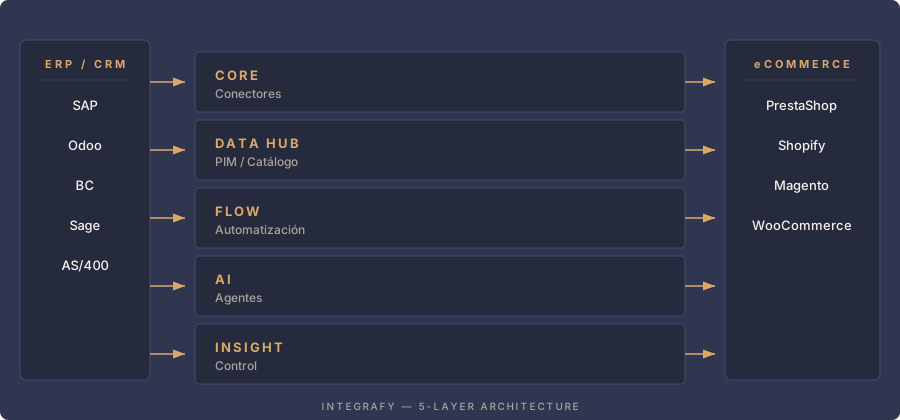
Layer diagram — each module runs independently and communicates via events.
The 5 layers of Integrafy
CORE
Connectors
Base connectivity layer. Abstracts communication with each external system via specific adapters. REST APIs, SOAP, flat files, intermediate databases. 100+ preconfigured connectors that normalize data from any ERP or eCommerce to a unified model.
- ▶ Two-way adapters
- ▶ Data normalization
- ▶ Credential management
- ▶ Automatic rate limiting
DATA HUB
Catalog and PIM
Master data layer. Centralizes products, stock, prices, tariffs and customers in a canonical model. Acts as golden record for every channel. Built-in PIM with enrichment, validation and multichannel distribution.
- ▶ Golden record
- ▶ Canonical model
- ▶ Conflict resolution
- ▶ Multichannel distribution
FLOW
Automation
Process orchestration layer. Defines complex business flows without code: orders, delivery notes, invoices, returns, price updates. Rule engine with conditions, transformations and branching. Event-driven execution with automatic retries.
- ▶ Rule engine
- ▶ Event-driven execution
- ▶ Retries with backoff
- ▶ Conditional flows
Agents
Intelligent agents
Intelligence layer over operational data. Analyzes order patterns, detects stock anomalies, suggests restocking. Exposes an MCP server that lets LLMs (Claude, ChatGPT) query and operate on ERP data in a controlled way.
- ▶ Anomaly detection
- ▶ Restocking suggestions
- ▶ MCP server
- ▶ Controlled data access
INSIGHT
Analytics and monitoring
Operational visibility layer. Real-time dashboards over syncs, errors and flow performance. Threshold-based alerts. Full transaction history for audit and troubleshooting.
- ▶ Real-time dashboards
- ▶ Threshold alerts
- ▶ Transaction traceability
- ▶ Performance metrics
Pipeline in action
What happens when an order hits PrestaShop?
From event to ERP in under 5 seconds. These are the five stages of the event-driven pipeline, with real latencies under production load.
- EXTRACT
Event capture
PrestaShop fires a webhook when the order is confirmed. Connect receives the payload, validates the signature and persists it as an immutable event in the input queue. If the webhook fails, Connect can also do scheduled pull — belt and suspenders.
- TRANSFORM
Normalization to the canonical model
Integrafy Data converts the PrestaShop payload to the internal model. It cross-checks the customer against the golden record, applies the ERP tariff and validates that reserved stock adds up. Any inconsistency is caught here, not in the ERP.
- ROUTE
Business orchestration
Flow applies the rules: customer segment, approval path, document type to generate (order, reservation, quote, direct delivery note). It decides on clean canonical data, not on dirty channel fields.
- LOAD
Writing to the ERP
Integrafy writes to the ERP through its native API: Service Layer (SAP B1), OData (Business Central), XML-RPC (Odoo), RFC/BAPI (SAP R/3), COM or SQL (Sage). Idempotency guaranteed: the same order is never duplicated, even if the event arrives twice.
- OBSERVE
End-to-end traceability
Observe records every stage with timestamp, latency and payload. Any operator can audit an order from the PrestaShop webhook to the final ERP document. One click, one timeline, zero doubt.
Total p99 latency under real load: < 5 seconds from webhook to confirmed ERP document.
ERP × eCommerce compatibility
Every combination is supported out of the box. Preconfigured connectors, production-ready.
| ERP / eCommerce | PrestaShop | Shopify | Magento | WooCommerce |
|---|---|---|---|---|
| SAP Business One | ✓ | ✓ | ✓ | ✓ |
| SAP R/3 (ECC) | ✓ | ✓ | ✓ | ✓ |
| Odoo | ✓ | ✓ | ✓ | ✓ |
| Business Central | ✓ | ✓ | ✓ | ✓ |
| Sage | ✓ | ✓ | ✓ | ✓ |
| AS/400 | ✓ | ✓ | ✓ | ✓ |
Key technical concepts
Data Fabric
Integrafy implements a Data Fabric approach: an abstraction layer that connects heterogeneous data sources without replicating or centralizing everything into a single repository. Data flows on demand between systems, keeping each source as owner of its own data.
Event-driven sync
Every change in a source system generates an event. Subscribed modules react in real time. No polling, no scheduled syncs wasting resources. When an order hits PrestaShop, the event reaches the ERP in milliseconds.
Idempotency
Every operation can be run multiple times without side effects. If an event is processed twice (for example due to a retry), the result is identical. This eliminates duplicate orders, ghost stock movements and accounting mismatches.
Error handling and retries
Every transaction has a full lifecycle: pending, in progress, completed or failed. Errors are classified by type (transient, permanent) and retried with exponential backoff. Dead letter queues for unrecoverable errors with immediate alert.
Want to see the architecture in action?
We’ll show you how Integrafy deploys onto your current stack.