
The semantic layer the AI understands.
Objects, Links and Actions — the vocabulary that describes your business. On top of that layer, LLMs can query data and execute authorized actions without guessing what your table names mean.
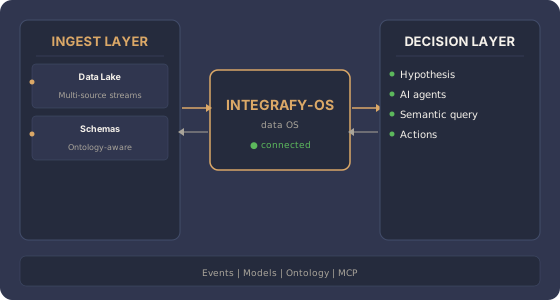
The three pillars of the ontology
Objects
The entities of your business with semantic meaning. Not "customer_b1 table", but Customer. Not "sales_order table", but Order. The AI can read it and refer to it.
Links
Relationships with their own name. A Customer "has" Orders, "belongs to" a Company, "is assigned to" a Sales Rep. Relationships convey context, not just foreign keys.
Actions
Operations that make sense in your business. "Cancel order", "Change pricing", "Generate delivery note". Each Action with authorization, auditing and business rules.
Why it matters: the same data, two interpretations
Without ontology: "What's the average margin per order this quarter?"
→ LLM sees tables: sales_order_h, items_lin, prod_prm, prc_cst
→ Has to guess which field is cost, which is price, which orders are in the quarter
→ Replies with a number that could be wrong due to an incorrect mapping
With Integrafy-OS ontology:
→ LLM sees: Object Order with property margin (calculated, documented)
→ Filters by quarter on the confirmation_date field
→ Replies correctly, with lineage of the calculation available to verify
Frequently asked questions about Ontology
What exactly is an ontology in Integrafy-OS?
A semantic layer that describes what each object is, how it relates to others and what you can do with it. It's more than a schema: it includes meaning (a Customer is not a bank account even if both have a number), relationships (a Customer has Orders, doesn't 'own' them), and authorized actions (an Order can be cancelled, but a Delivery Note can't). This is what enterprise data platforms call an Ontology.
Why does the AI need an ontology?
Because without it, an LLM sees SQL tables with cryptic names and has to guess what they mean. With an ontology, the AI knows that 'customer_b1' is a Customer, that 'sales_order_header' is an Order, and that 'cancel order' is a valid action on it. This multiplies the accuracy of any AI × data interaction.
How is the ontology exposed to the AI?
Via an MCP (Model Context Protocol) server. Claude, ChatGPT and other LLMs connect to the server and automatically discover the available Objects, Links and Actions. They can query data and execute authorized actions, but can't access anything outside their permissions.
Are Actions the same as endpoints?
Related but different. An endpoint is technical (POST /api/orders/:id/cancel). An Action is semantic ('Cancel order, requires reason, only for orders not yet shipped, audited, notifies the customer'). An Action knows the business context; an endpoint doesn't.
Can the ontology be extended without touching code?
Yes. Adding new Objects, Links or Actions is done from the visual UI. The MCP server updates automatically and the AI discovers what's new without restarting anything.
Does your AI understand your business, or does it guess?
MCP ontology demo in 30 minutes.